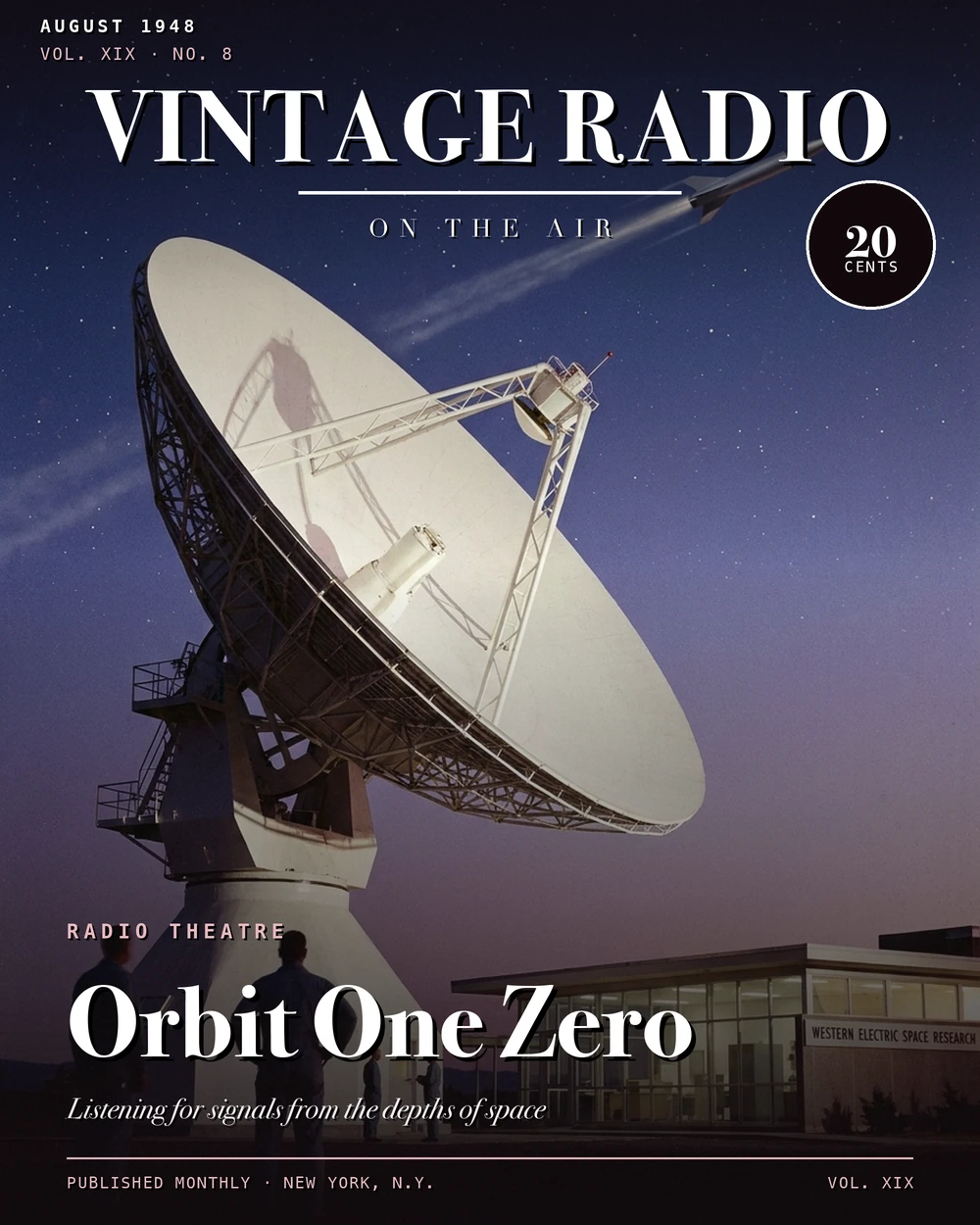
Orbit One Zero
What It Was
Orbit One Zero is a six-episode Science Fiction serial produced by the BBC, written by Peter Elliott Hayes and produced by David Davis. It went out on the BBC Home Service between April 21 and May 26, 1961, with each episode running roughly thirty minutes — just under three hours of drama in total. The story centers on a remote radio telescope station on the Hebridean island of Scara, off the west coast of Scotland, where a professor has been picking up signals that appear to originate from an extraterrestrial intelligence.
The serial has a clever narrative frame. Journalist Tom Lambert, looking back a decade, tracks down retired astrophysics professor Dr. Hayward Petrie to reinvestigate what happened on Scara. The main story unfolds in flashback, drawn from Petrie's own recordings — a structure that gives the drama an air of recovered testimony, as though the listener is piecing the events together alongside Lambert.
The Story and the Cast
Felix Felton played Dr. Hayward Petrie, the central figure whose recordings anchor the narrative, and David Spenser played journalist Tom Lambert. The supporting ensemble filled out the world around them: Graydon Gould as student Clifford Brown, Elaine MacNamara as Elizabeth Ryder, Ian Sadler as Professor Campbell McLaren, Harold Reese as Peter Garrick, William Fox as Sir Edward Bancroft, Basil Jones as Mr. Morgan and Dr. Trevor Hughes, Charles West as Lord Hetherton, and Eric Lugg as the Police Superintendent.
The plot's engine is Professor McLaren's discovery of an unusual signal pattern at his isolated Scara station. While there, students Clifford Brown and Elizabeth Ryder find a mysterious glowing cylindrical object buried on the beach. The cylinder's contents and capabilities drive the serial toward its climax, with the object ultimately tied to a source of gamma radiation in space. The six episodes, in broadcast order, are "The Unseeing Eye," "The Cylinder," "The Power," "The Voices," "The Frozen World," and "The Unseen."
The Sound of It
The production drew notice for its use of sound effects and radio technology to build an outer-space atmosphere. For a 1961 BBC serial aimed at listeners rather than viewers, the audio design carried the weight of making the unknown feel genuinely strange — the difference between a script and an experience. The recurring themes of discovery and the unknown, and stories built around missions into deep space, gave the writers and sound designers consistent territory to work in.
Hayes, the writer, also worked on other BBC radio and screen projects, including The Red Grass and Francis Storm Investigates. Orbit One Zero sits alongside other British and American Science Fiction radio dramas of the period, though it did not achieve the same level of recognition as programs like Dimension X.
After 1961
The serial has had a longer afterlife than its original six-week run might suggest. BBC Radio 4 Extra has rebroadcast it, including a run from June 29 to August 3, 2025, and in 2024 BBC Studios Distribution Ltd re-released it as a commercial audiobook, described as a "full-cast BBC Radio Classic Sci Fi Drama." That a serial produced for a single spring season in 1961 remains in active circulation more than sixty years later says something about the durability of the premise and the craft of the production. The drama arrived in the early 1960s, when real space missions were beginning to make the subjects of alien signals and cosmic discovery feel less like fantasy and more like open questions.